
LM Contracts Services Ltd logo

Surface Coatings in Hillsborough

County Down about 14 miles from Glenavy

Protective and decorative coatings for masonry, render, concrete and hard surfaces, chosen for the substrate and the exposure rather than pulled off a shelf. We cover Hillsborough as part of our normal working area, with no travel charge added.

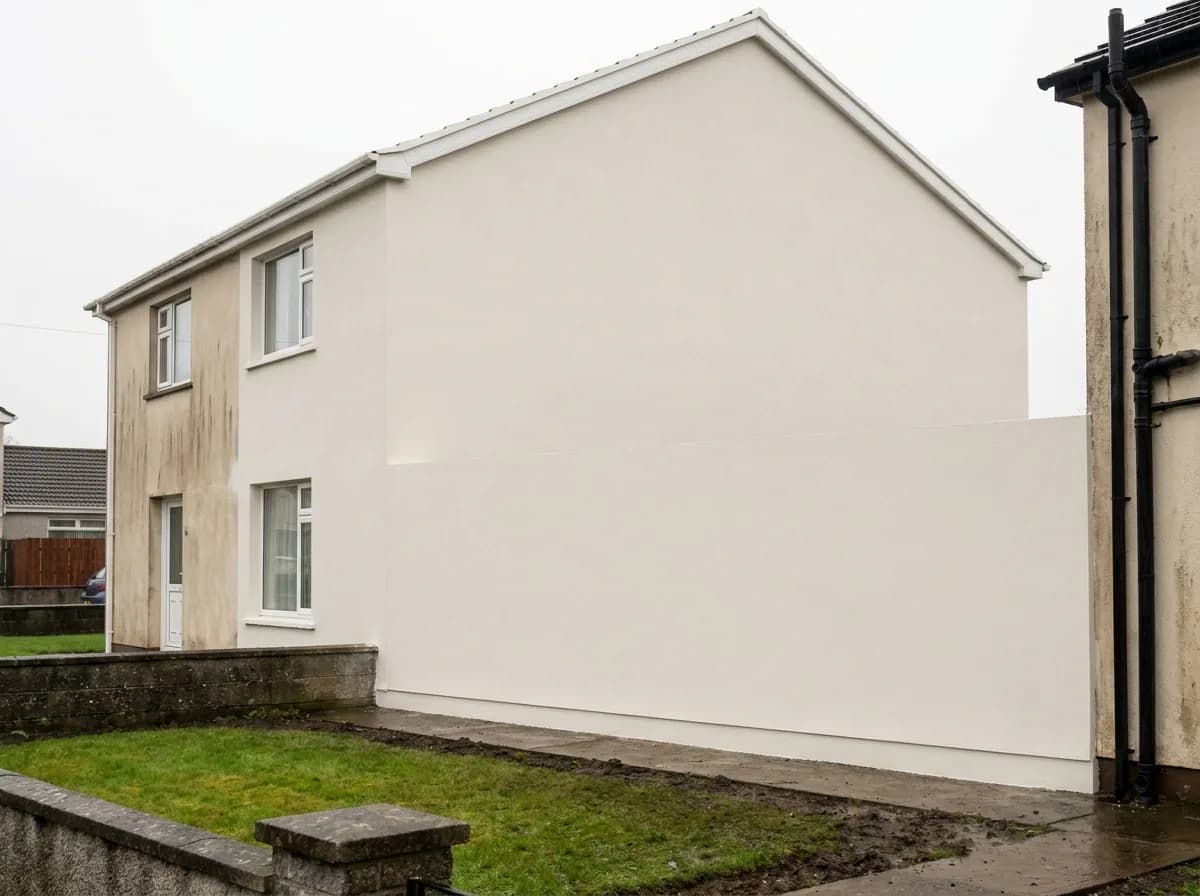
House gable freshly finished in a smooth off-white render coating, with a section of older weathered render visible alongside for contrast
Based in Glenavy, County Antrim
Residential and commercial work
Free, no-obligation quotations
Careful preparation on every job

Local context

Surface Coatings for Hillsborough property

The village core is Georgian and early Victorian, with a high concentration of listed buildings and a conservation area covering the historic centre. Older solid-wall construction here needs vapour-permeable specification as a matter of course. Around the village there is substantial modern high-specification housing where the brief is usually about quality of finish rather than repair.

In a conservation area, changing the external appearance or applying a modern coating to historic fabric can need consent and can be actively inappropriate on older masonry. We will raise it, and we would expect the council to be consulted before work starts.

Solid-wall stone and older rendered properties here are exactly the case where breathability matters. Sealing this kind of wall with the wrong coating causes more problems than it solves, so the specification conversation comes before the colour one.

Newer render systems here are usually in sound condition, so the work tends to be about consistency, tidying up where an extension or a repair has left a mismatch across the elevation.

Listed status and conservation area designation are a genuine constraint in the village centre, not a formality. External appearance changes can need consent, and on historic fabric a modern sealed coating can be actively inappropriate. We raise this before quoting.

Specifying for the substrate rather than the shelf

The single most useful thing a contractor can do on coating work is choose the right product for what is actually there. Concrete, sand and cement render, through-coloured render, brick, block and natural stone all behave differently, and they do not all want the same coating.

The biggest distinction is breathability. Older solid-wall construction generally needs to let moisture vapour out. Put a sealed, film-forming coating on a wall like that and moisture accumulates behind it, which shows up as blistering, patchy damp inside, and in a bad winter as frost damage to the masonry itself. A vapour-permeable mineral coating on the same wall behaves completely differently.

So the first conversation is about the building, not the colour chart.

Why the old coating failed

If there is already a coating on the surface and it has failed, that is useful information and it is worth diagnosing rather than just covering.

Flaking in sheets usually means a bond failure, either poor preparation originally or moisture pushing from behind. Blistering usually means trapped moisture. Chalking, where the surface leaves powder on your hand, is normal weathering of the binder. Patchy discolouration and dark growth generally means persistent damp, which is often a defective gutter, a bridged damp proof course or a leaking downpipe rather than a coating problem at all.

That last one matters. Coating over a wall that is wet because a gutter has been overflowing for three years is money spent to hide a symptom. We would rather point at the gutter.

Preparation

The pattern is the same as the rest of our work. Everything loose, flaking or powdering comes off. Organic growth, moss, algae and lichen is removed and treated, because it will grow back through a new coating otherwise. Cracks and defects are cut out and repaired with a compatible material. Surfaces are cleaned down and left sound and stable.

Only then does anything decorative happen, and a suitable primer or stabiliser goes on first where the surface calls for it.

Being straight with you

What it suits, and what it does not

What this suits

  • Render and sand and cement surfaces
  • Concrete and blockwork
  • Masonry and stonework
  • Boundary and garden walls
  • Previously coated surfaces where the existing coating is sound or can be removed
  • Commercial frontages, yards and external hard surfaces

What it does not suit

  • Surfaces that are wet because of an unresolved defect, until the cause is fixed
  • Substrates where sealing would trap moisture in the structure, unless a vapour-permeable system is specified
  • Timber, which is a different trade
  • Surfaces with significant structural cracking, which needs investigation first

Our process

How the work runs in Hillsborough

  1. 01

    Assessment

    Identify the substrate, check for moisture and its cause, and understand why any previous coating failed.

  2. 02

    Specification and quotation

    Set out the system, the preparation and the finish, including whether a breathable coating is needed and why.

  3. 03

    Clean and strip

    Loose and failed material removed, organic growth cleaned off and treated.

  4. 04

    Repair

    Cracks and defects cut out and made good with compatible materials.

  5. 05

    Prime or stabilise

    Appropriate primer or stabilising solution where the surface needs it.

  6. 06

    Apply the coating

    Applied to the specified number of coats and build, with adjacent surfaces protected throughout.

  7. 07

    Inspect and clear up

    Finish checked over, protection removed, site left clean.

Cost

What drives the price

  • Surface area and the height of the elevation
  • Condition of the existing surface and how much preparation and repair it needs
  • Whether a failed coating has to be removed
  • Access and whether scaffold or towers are required
  • Coating system, particularly where a breathable mineral system is specified
  • Texture and finish choice

Coating work is quoted per project after assessment. The variable is nearly always the condition of what is already there and the access needed, rather than the coating itself, so a square metre rate quoted without seeing the building is not worth much.

Questions

Surface Coatings in Hillsborough, answered

Do you carry out surface coatings in Hillsborough?

Yes. Hillsborough is about 14 miles from our base in Glenavy, comfortably inside the area we cover, and we work there regularly.

How much do you charge to travel to Hillsborough?

Nothing extra. Hillsborough sits within our normal working radius, so travel is not added to the quotation.

What kind of properties do you usually work on in Hillsborough?

The village core is Georgian and early Victorian, with a high concentration of listed buildings and a conservation area covering the historic centre. Older solid-wall construction here needs vapour-permeable specification as a matter of course. Around the village there is substantial modern high-specification housing where the brief is usually about quality of finish rather than repair.

How is this different from just painting the wall?

Masonry paint is one option among several and sometimes it is the right one. The difference is in specifying for the substrate: choosing between a film-forming and a vapour-permeable system, deciding whether the surface needs stabilising first, and diagnosing why any previous coating failed rather than covering it.

My render keeps flaking. Will a new coat fix it?

Only if you find out why it is flaking first. Flaking in sheets is usually a bond failure or moisture pushing out from behind. If the wall is wet because of a defective gutter, a leaking downpipe or a bridged damp proof course, a new coating will fail the same way. We would rather identify that and tell you than take the job twice.

What is a breathable coating and do I need one?

A vapour-permeable coating lets moisture vapour pass out through the wall instead of sealing it in. Older solid-wall construction generally needs this. Sealing such a wall with a film-forming coating can cause blistering, internal damp and frost damage to the masonry. Whether you need one depends on how your wall is built, which is something we check on site.

Will it stop damp inside my house?

Usually not on its own, and we would be cautious of anyone who promises it will. External coatings can reduce water absorption into a wall, but internal damp is far more often caused by a specific defect or by condensation. Fix the cause first, then coat.

Can you match an existing finish?

Often, yes, particularly where you are extending or repairing part of an elevation. Bring it up at the quotation stage so we can look at the existing texture and colour before choosing a system.

Do you remove moss and algae first?

Yes, always, and it is treated rather than just brushed off. Organic growth left on a surface will grow back through a new coating, and it also indicates the surface stays damp, which is worth understanding before specifying.

How long does coating work take?

It depends on the area, the amount of preparation and the access. A small elevation might be a couple of days including preparation, a full house with scaffold considerably more. Coats also need time between them, and cold or damp weather extends that.

Can it be done in winter?

Some of it, in settled conditions. Most external coatings have minimum application temperatures and must not take rain while curing, so winter work depends heavily on the forecast and dates can move.

Will it change the appearance of my house?

Yes, that is generally the point, but it is worth being aware that if your property is listed or in a conservation area, changing the external appearance may need consent. We will flag it if we think it might apply, and we would expect you to confirm with the council before we start.

How long will it last before it needs doing again?

We do not publish a lifespan figure, because it depends enormously on the system, the exposure of the elevation and how well the surface was prepared. What we can say is that a correctly specified and properly prepared coating outlasts a badly prepared one by a wide margin, which is where the effort goes.

Do you do garden and boundary walls?

Yes. They are often more exposed than the house itself, taking weather from both sides and sitting with no roof overhang, so they are worth specifying carefully rather than treating as an afterthought.

Surface Coatings in Hillsborough

Free quotation, no obligation, and an honest answer about whether this is the right job for your property.

CallWhatsAppFree quote