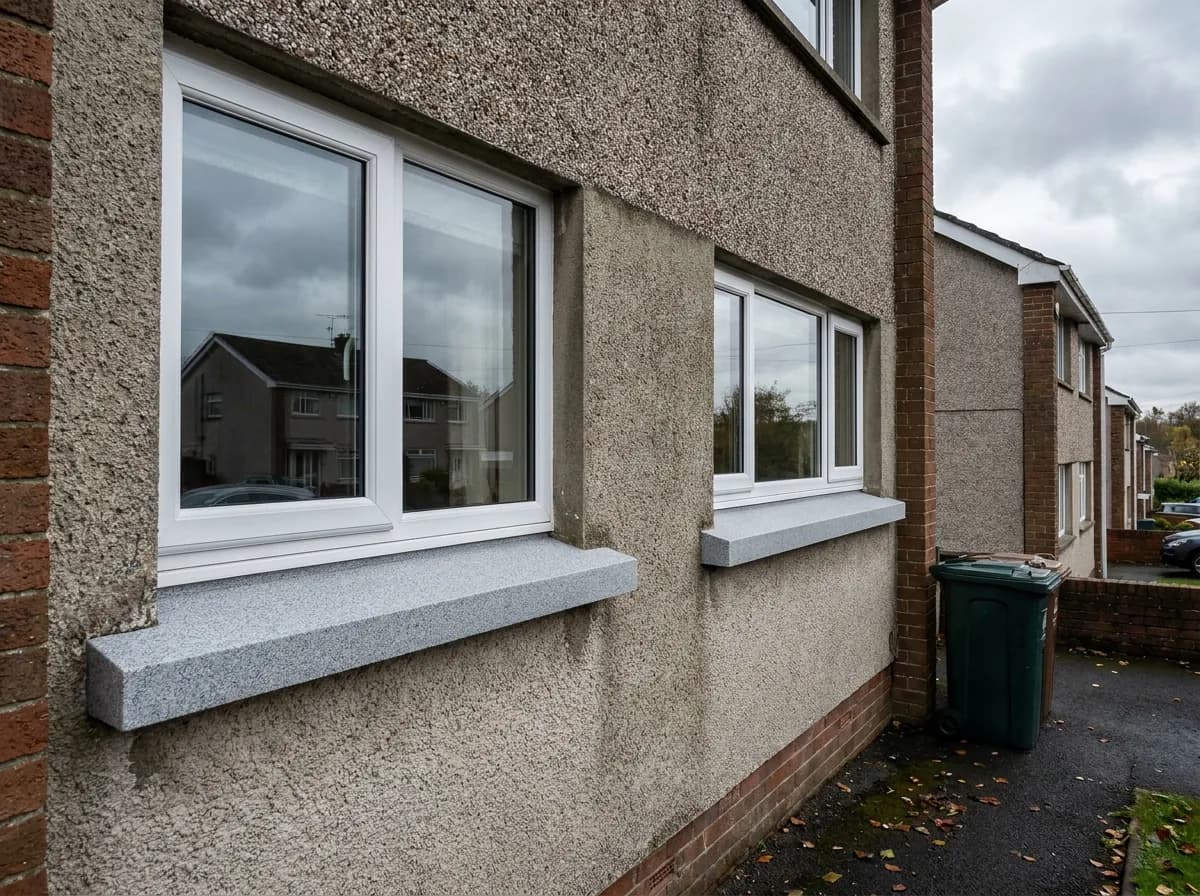
Antrim expanded enormously through the second half of the twentieth century, which means there is a large volume of estate housing built to consistent specifications with standard cast concrete sills, now at the age where surface deterioration is widespread. Alongside that there is older stone property around the town centre and the castle grounds, plus a genuine industrial base with commercial floors to match.
The post-war and 1960s to 1980s housing here was built with standard cast concrete sills, and they are now at exactly the age where the surface starts crumbling and paint stops holding. They are the most common sills we coat, and because the openings are a consistent size across a street the work is efficient.
Commercial frontages and units here benefit from sill restoration as a low-disruption way to tidy an elevation without closing anything or touching the glazing. It is generally scheduled around trading hours.
Newer developments here tend to have reconstituted stone or cast sills that are structurally fine but can look dull, stained or mismatched after a decade, particularly where an extension has been added. Restoring the whole elevation to one consistent finish is usually the goal rather than fixing damage.
Older stone and rendered properties around here often have deep cast sills that have taken decades of weather on exposed elevations. They are usually well worth restoring rather than cutting out, because the sill profile itself is generous and sound under the surface damage.
The volume of consistently built estate housing here makes full-elevation sill restoration particularly cost-effective, because the openings repeat and the setup carries across the whole house.