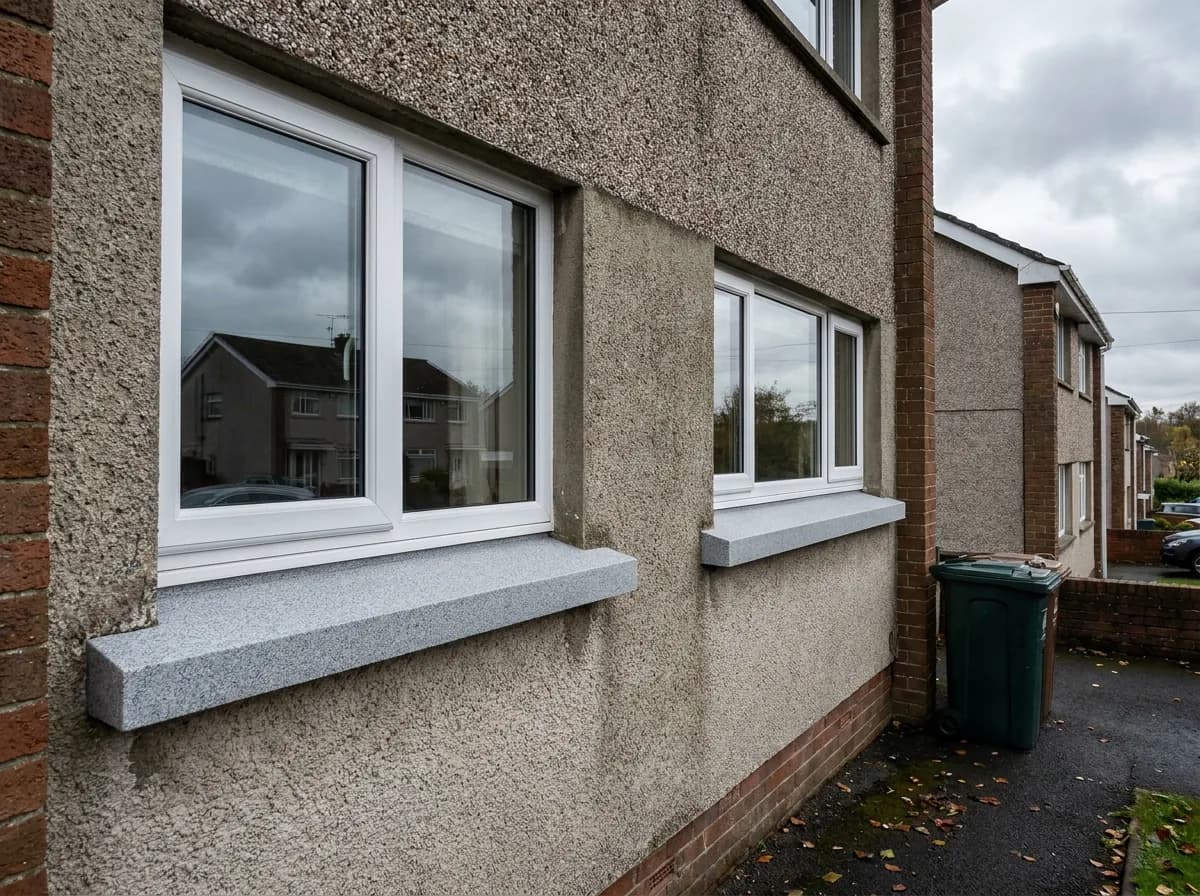
There is a clear split in Crumlin between the older stone and rendered property in and around the village centre and the substantial post-war and later housing estates that have been added on the edges. The older stock tends to have deep cast sills and solid walls that need a breathable approach, while the estate housing has the standard concrete sills now reaching the age where the surface starts letting go.
Older stone and rendered properties around here often have deep cast sills that have taken decades of weather on exposed elevations. They are usually well worth restoring rather than cutting out, because the sill profile itself is generous and sound under the surface damage.
The post-war and 1960s to 1980s housing here was built with standard cast concrete sills, and they are now at exactly the age where the surface starts crumbling and paint stops holding. They are the most common sills we coat, and because the openings are a consistent size across a street the work is efficient.
Bungalows on open sites here take wind-driven rain across the full elevation with little shelter, and the sills show it first. The advantage is that almost everything is at ground floor level, so there is no access equipment to price in and a full house is typically a single visit.
Farmhouses and converted outbuildings here often have a mix of original stone sills and later concrete replacements on the same building, so matching the finish across the lot is usually the main brief.
Crumlin Glen and the older property around it sits in a genuinely damp, sheltered, tree-shaded pocket, and north-facing surfaces there hold moss and algae far more stubbornly than the open ground a mile away.