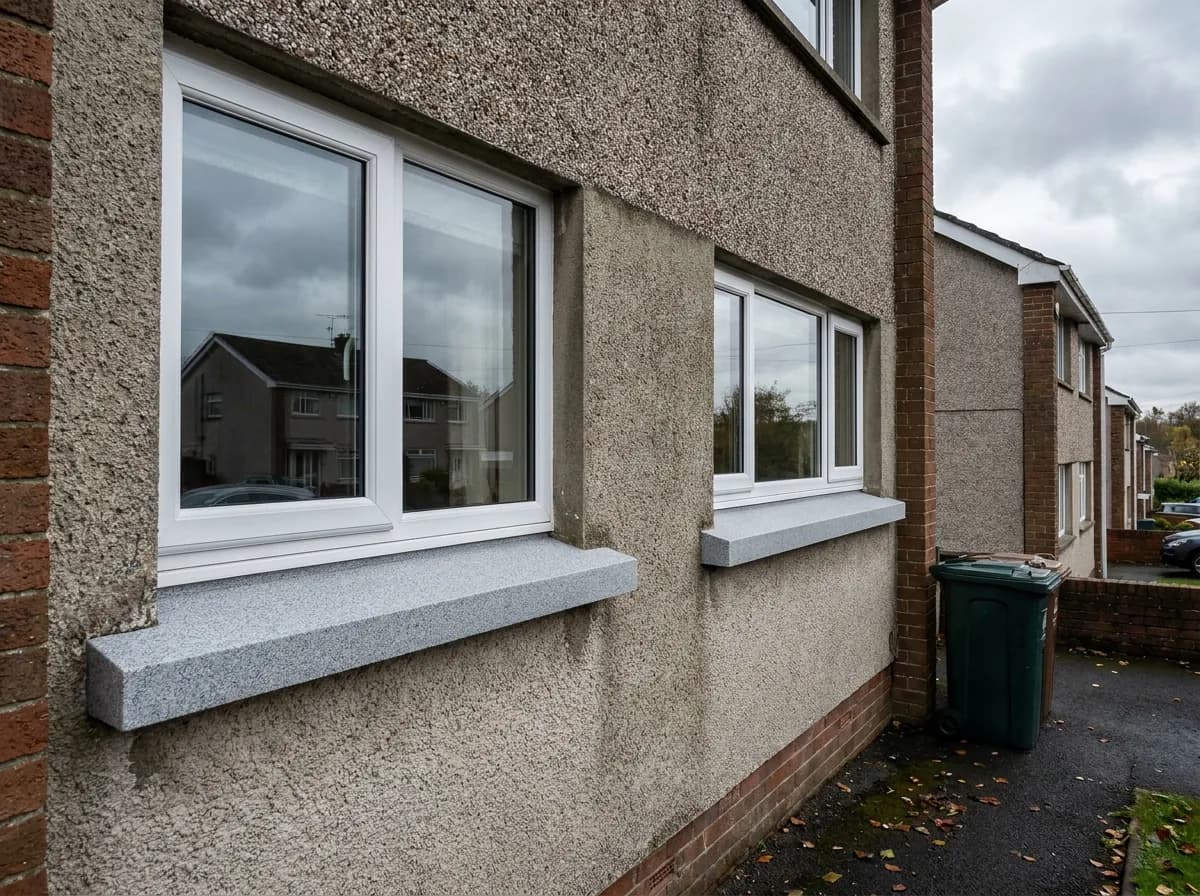
Almost every kind of property we work on exists in Lisburn. There is older terraced and townhouse stock around the centre, very large amounts of post-war and 1960s to 1980s estate housing through Old Warren, Lambeg and the outer districts, modern development on the edges, and a real concentration of commercial and light industrial units. The post-war housing is where most of our sill work comes from, because those cast concrete sills are now at exactly the age where the surface starts breaking down.
The post-war and 1960s to 1980s housing here was built with standard cast concrete sills, and they are now at exactly the age where the surface starts crumbling and paint stops holding. They are the most common sills we coat, and because the openings are a consistent size across a street the work is efficient.
Newer developments here tend to have reconstituted stone or cast sills that are structurally fine but can look dull, stained or mismatched after a decade, particularly where an extension has been added. Restoring the whole elevation to one consistent finish is usually the goal rather than fixing damage.
Terraced and older townhouse stock here often has narrow sills sitting hard against the pavement or a small front garden, catching splash-back as well as direct rain. Access is straightforward at ground floor but masking matters more when the sill is a foot from a public footpath.
Commercial frontages and units here benefit from sill restoration as a low-disruption way to tidy an elevation without closing anything or touching the glazing. It is generally scheduled around trading hours.
The scale of consistent estate housing here works in your favour on sill restoration. Where a street was built to one specification the openings are a standard size, which makes the work efficient and the quotation straightforward.