LM Contracts Services Ltd logo

Window Sill Restoration in Glenavy

County Antrim our home village

A trowel-applied stone chip finish that turns cracked, stained and weather-beaten concrete sills into a hard granite-effect surface, without the cost and disruption of cutting sills out. We cover Glenavy as part of our normal working area, with no travel charge added.

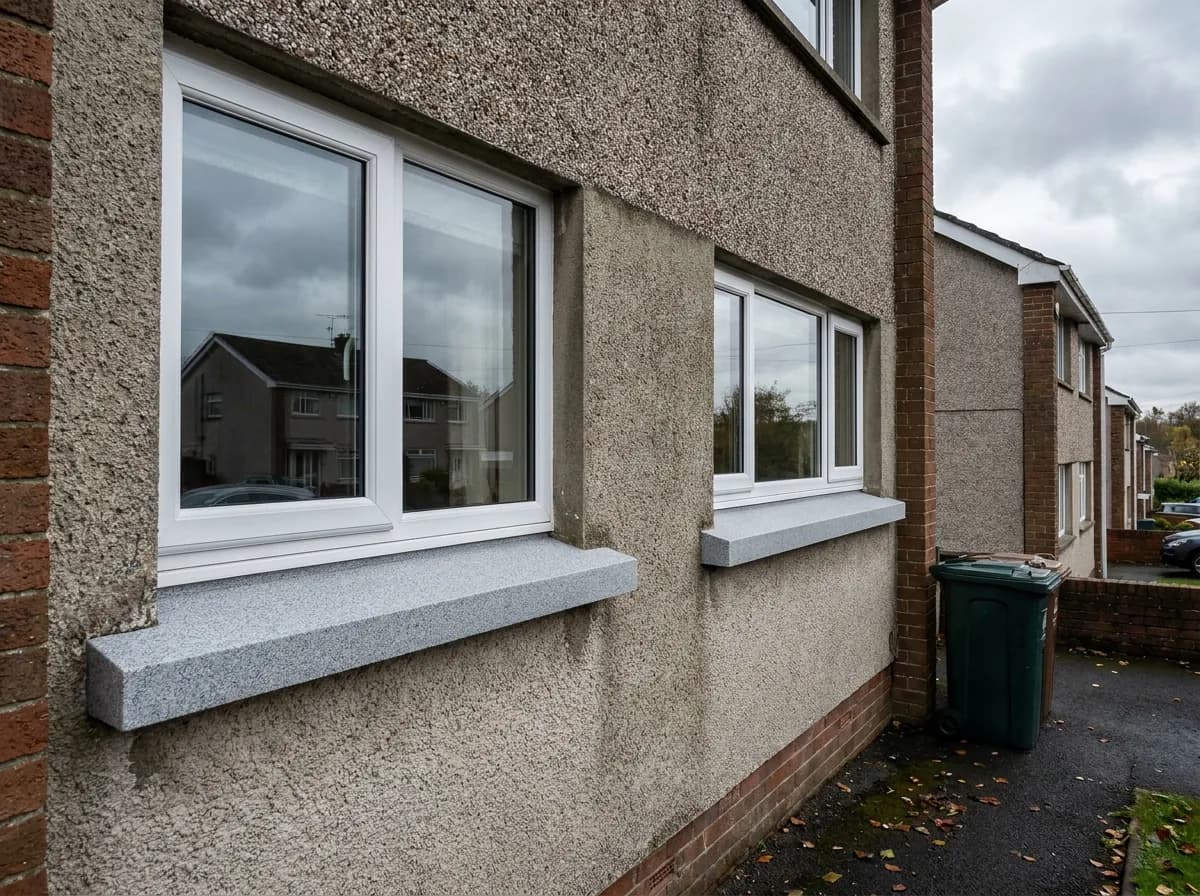
Restored granite-effect window sills on a pebbledash semi-detached house, showing the clean square front edge beneath white uPVC windows
Based in Glenavy, County Antrim
Residential and commercial work
Free, no-obligation quotations
Careful preparation on every job

Local context

Window Sill Restoration for Glenavy property

Glenavy's building stock runs from older stone and rendered village property along the main street through to post-war housing and a good deal of detached rural bungalows and farmhouses on the roads out toward Ballinderry and the lough. It is a genuine mix rather than one dominant era, so almost every kind of sill, slab and external surface we work on is represented within a couple of miles of the yard.

Older stone and rendered properties around here often have deep cast sills that have taken decades of weather on exposed elevations. They are usually well worth restoring rather than cutting out, because the sill profile itself is generous and sound under the surface damage.

Bungalows on open sites here take wind-driven rain across the full elevation with little shelter, and the sills show it first. The advantage is that almost everything is at ground floor level, so there is no access equipment to price in and a full house is typically a single visit.

The post-war and 1960s to 1980s housing here was built with standard cast concrete sills, and they are now at exactly the age where the surface starts crumbling and paint stops holding. They are the most common sills we coat, and because the openings are a consistent size across a street the work is efficient.

Farmhouses and converted outbuildings here often have a mix of original stone sills and later concrete replacements on the same building, so matching the finish across the lot is usually the main brief.

Being based in the village means no travel time is priced into a Glenavy job, and it is straightforward for us to call back if you want something looked at again.

What actually goes on the sill

The finish is a natural stone chip aggregate held in a binder, not a paint and not a coloured sealer. That distinction matters, because the colour and the texture come from real crushed mineral running through the full thickness of the material rather than from a pigment sitting on the surface. Paint on an exposed sill fails from the top down, so the first thing you see is the colour going patchy. A stone chip system wears differently, because there is no thin coloured film to lose.

It is applied by steel trowel at roughly one to two millimetres over a primed sill. Once it has gone off it is a hard, slightly textured surface, water resistant and stable under UV, so it does not bleach out on a south-facing elevation the way a coloured coating can.

Should you restore or replace?

The honest answer depends on what is actually wrong with the sill, and it is worth being straight about this because it decides whether we can help you at all.

Restoration is the right call when the sill is sound but ugly: surface crumbling, staining, algae, hairline crazing, failed paint, or a colour you have never liked. That covers the large majority of tired sills on houses built from the 1950s onward.

Replacement is the right call when the sill has genuinely failed: deep structural cracking straight through, significant sections broken away, exposed and corroding reinforcement, or a sill that has dropped and is no longer throwing water clear of the wall below. A coating over a failed sill hides the problem for a season and then tracks the same crack. We will tell you if that is what we are looking at, and we would rather lose the job than coat something that is going to fail.

Preparation is most of the job

Almost every coating failure on external masonry comes back to preparation, so this is where the time goes. Loose, flaking or powdering material has to come off entirely, because anything left behind becomes the weak layer the new finish sits on. Moss, algae, dirt and any lifting paint are cleaned off. Deeper cracks and lost corners are made good with a suitable repair mortar and allowed to set, so the sill is a continuous, sound surface before anything decorative happens.

The prepared sill is then dampened and primed with a bonding primer before the finish goes on. Frames, glass, render and anything below the sill are masked, because this is trowel work directly under a window and overspill on a frame is easy to create and unpleasant to remove.

Being straight with you

What it suits, and what it does not

What this suits

  • Concrete and cast concrete sills
  • Natural and reconstituted stone sills
  • Rendered and masonry sills
  • Sills that are weathered, stained or surface-crumbling but structurally sound
  • Matching sill detail across a full elevation for a consistent look

What it does not suit

  • uPVC sills and uPVC sill covers, which this system is not designed to bond to
  • Tiled sills
  • Internal window boards and worktops
  • Sills with deep structural cracking, dropped sections or corroding reinforcement, which need repair or replacement first
  • Floors and any high-wear walking surface

Quick sill quote for Glenavy

Four short steps. Postcode, roughly how many sills, an optional photo, and where to send the answer.

  1. Postcode
  2. Sills
  3. Photo
  4. Contact

Step 1 of 4

Where are the sills?

Your postcode tells us straight away whether you are inside our working area.

Our process

How the work runs in Glenavy

  1. 01

    Look at the sills

    We assess each sill for what is genuinely wrong with it and confirm the substrate is one the system suits. This is also where we tell you if any sill needs repair or replacement rather than coating.

  2. 02

    Written quotation

    Priced per opening, so you can see exactly what you are paying for and drop or add windows without renegotiating the whole job.

  3. 03

    Strip back and clean

    Loose and flaking material removed, moss, algae, dirt and lifting paint cleaned off, back to a sound surface.

  4. 04

    Repair and make good

    Cracks, chips and lost corners filled with a suitable repair mortar and allowed to set, so the finished profile is right before anything decorative goes on.

  5. 05

    Mask and prime

    Frames, glass and surrounding render protected, then a bonding primer applied to the prepared sill.

  6. 06

    Apply the stone finish

    Trowel applied at roughly one to two millimetres, edges dressed while the material is fresh so the arris is clean and consistent.

  7. 07

    Cure and clear up

    Protected while it cures, masking removed, site left clean. We tell you plainly when it is safe to take rain and when it is fully hard.

Cost

What drives the price

  • Number of openings, which is the main driver
  • Sill width and depth, since bays and picture windows take far longer than standard openings
  • How much repair the sills need before they can be coated
  • Access, in particular whether first floor sills need towers or scaffold
  • Colour and finish choice

Sill restoration is priced per opening rather than by square metre, because preparation time varies so much from sill to sill. We quote on site after looking at the actual condition, and the quotation is free. We do not publish a price list, because a number that ignores the state of your sills would be misleading.

Questions

Window Sill Restoration in Glenavy, answered

Do you carry out window sill restoration in Glenavy?

Yes. Glenavy is where we are based, comfortably inside the area we cover, and we work there regularly.

How much do you charge to travel to Glenavy?

Nothing extra. Glenavy sits within our normal working radius, so travel is not added to the quotation.

What kind of properties do you usually work on in Glenavy?

Glenavy's building stock runs from older stone and rendered village property along the main street through to post-war housing and a good deal of detached rural bungalows and farmhouses on the roads out toward Ballinderry and the lough. It is a genuine mix rather than one dominant era, so almost every kind of sill, slab and external surface we work on is represented within a couple of miles of the yard.

Is this just painting my sills?

No. Paint is a thin coloured film on the surface, which is why it fails from the top down and needs redoing every few years. This is a natural stone chip aggregate in a binder, trowel-applied at roughly one to two millimetres, so the colour and texture run through the material rather than sitting on top of it.

Can you coat uPVC sills?

No. The system is designed for concrete, stone, render and masonry. uPVC is not a substrate it is intended to bond to, and we will not apply it to one and hope. If you have uPVC sills, uPVC sill covers are the usual route and that is a different trade.

Will it crack or flake off later?

The common causes of failure are coating over loose material, coating over a sill that has a live structural crack, or applying it in the wrong weather. All three are preparation and judgement issues rather than problems with the material, which is why we spend most of the job on preparation and why we will decline a sill that needs replacing.

How long does it last?

We do not publish a lifespan figure, because we have not got long-term data on our own installations to stand over and we are not going to quote someone else's marketing number as if it were ours. What we can tell you factually is that the cured finish is water resistant and UV stable, so it does not have the repainting cycle a painted sill has.

How much does it cost?

It is priced per opening after we have looked at the sills, and the quotation is free. Cost is driven by how many windows you have, how wide the sills are, how much repair they need first, and whether first floor access needs equipment.

How long does a house take?

Usually one day for preparation and application on a standard house, occasionally two where sills need significant making good first or where there are a lot of openings. Then it needs to stay clear of rain for about twenty four hours, or nearer forty eight in cold or damp weather.

Can it be done in winter?

It can, but only in a settled spell. The material must not be applied in frost and must not take rain while it cures, so between roughly November and February we are working around the forecast and dates can move. We would rather reschedule than apply it in the wrong conditions.

Do you have to remove the old paint?

Anything loose or lifting comes off, yes. Sound, well-adhered paint is cleaned and prepared rather than necessarily stripped to bare concrete. What we will not do is coat over paint that is already letting go, because the new finish would only be as good as the layer underneath it.

What colours are available?

Stone chip finishes come in a range of natural granite tones, from pale silver-greys through mid greys to darker charcoal and warmer speckled blends. We will show you the actual options at the quotation stage, because a colour on a screen is not a colour on a sill.

Will it damage my windows or render?

Frames, glass and surrounding render are masked before any material goes near them. This is trowel work directly beneath a window, so masking is not optional and we do not treat it as such.

Can you match it across an extension or a repair?

Usually, yes, and matching the sill detail across the whole elevation is a common reason people call us. It is worth mentioning at the quotation stage so we can look at the existing finish before choosing.

Do you do just one or two sills?

We do, though the economics are better across a full house because most of the cost is in setting up, masking and preparation rather than in the material. If you have one badly weathered sill it is still worth asking.

Window Sill Restoration in Glenavy

Free quotation, no obligation, and an honest answer about whether this is the right job for your property.

CallWhatsAppFree quote